
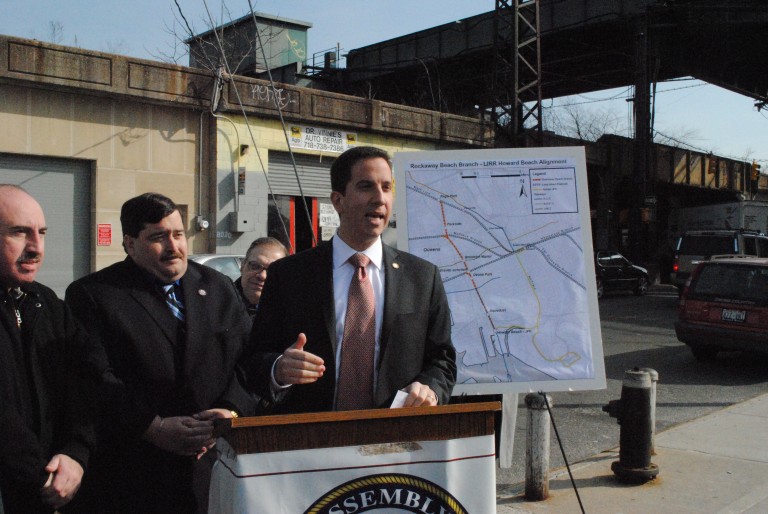
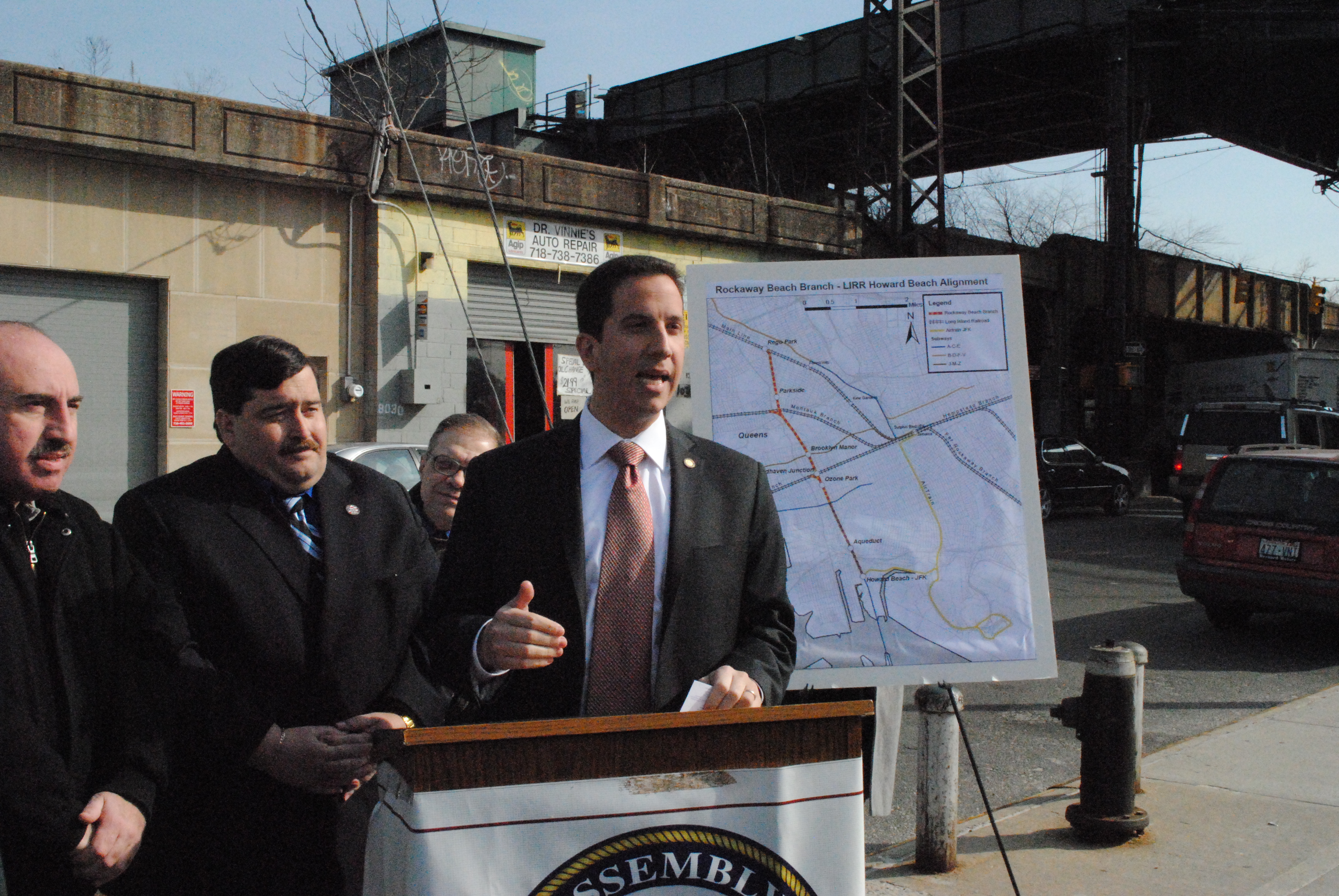
With part of the defunct LIRR Rail Road Rockaway Beach line on Liberty Avenue in the back- drop, state Assemblymen Phil Goldfeder, third from left, and Mike Miller, second from right, stood alongside mass transit advocates as they unveiled their plans to push for reactivating the branch lines to improve transportation for people in central and southern Queens.
With subway trains zipping overhead at the corner of Liberty Avenue in Ozone Park, local legislators and transportation advocates last week shared their vision of what a reactivated train would bring to central Queens.
In a joint press conference on Feb. 9, State Assemblymen Phil Goldfeder and Mike Miller joined others in calling for the rehabilitation of the currently defunct Rockaway Beach Rail Line in order to have trains actively connecting communities in central and southern Queens, as well as the Rockaway Peninsula.
Goldfeder, who has come forward recently as a vocal proponent of the move, pointed to the increased traffic coming in as a result of the October opening of Resorts World Casino as a main reason why trains need to be coming across the Rockaway Beach branch line of the Long Island Rail Road (LIRR), which extends 3.5 miles from Rego Park through the Rockaways. The line has been inactive since 1962.
“We have a problem; we have a tremendous transportation problem, and this is the answer,” he said.
Proponents are suggesting two options for bringing back train service along a 4.2-mile segment of railways along the Rockaway Beach line between Rego Park and the Aqueduct.
The first option would have the LIRR resume service between Penn Station and Aqueduct,with two stations being built at each respective location. Aqueduct would allow transfers to both the A train and Airtrain.
Meanwhile, the subway option would divert the R or M subway line east of 63rd Drive to the northern section of the Rockaway line. The subway would converge with the A train north of the Aqueduct Station and continue into the Rockaways; while at Rego Park, two stations would be built—one for the subway and one for the LIRR mainline—to allow riders to transfer between the two services.
To finance the new rails, Goldfeder and Miller said they would have to look towards getting a yet-to-be-specified portion of the $4 billion in private funding that is allegedly coming in to the proposed convention center, as well as turn to the local, state and federal governments to finance are vitalized railway.
Miller noted that his constituents have complained to him in the past about the traffic congestion problems getting from Glendale to Middle Village and on Cross Bay Boulevard in Howard Beach; he also added that recent discussions he had with the Department of Transportation revealed that there is no plan in the works to address traffic problems in the area in the next ten years.
“We know that there are trees growing there,and the rail has to be fixed and everything needs to be done…but there is an opportunity to build with a new convention center,” he said.
Another proponent was George Haikalis, president of the Institute for Rational Urban Mobility, a nonprofit that studies ways to improve transit around New York City through transportation reform.
Haikalis said that having the dead rail lines running again would connect central and southern Queens to the city and serve as an economic boost for local businesses thanks to more development opportunities, and generate tourism around the area.
“We think that you have to have the carrot and the stick in order to shift people from cars to public transit, and the carrot is right behind us here, this Rockaway line that is disused for 50 years,” he said.
On questions of how a new rail line would affect local businesses near its tracks, officials said there would have to be studies on that, while other proponents believed that a reactivated train line shouldn’t have any effect on local stores.
John Rozankowski, a mass transit advocate from the Bronx, was one of them. “I grew up in the Bronx. [Trains] become a part of life,” he told The Forum. “It’s something you just get used to.”
However, their plan clashes with another plan by officials pushing for the Queensway project—which would turn the abandoned rail line into a greenway, which is open space linking parks and communities around the city and providing public access to green spaces and waterfronts.
Andrea Crawford, chairwoman of Community Board 9 and a supporter of the Queensway, was critical of the plan to reactivate trains on the abandoned rail line recently, saying that it would cause an environmental “nightmare.”
If there is enough space, the restored rail lines could also include a greenway with hiking paths and bike trails, according to the railroad plan.
Goldfeder and Miller both offered that they would be willing to work with Queensway officials in order to compromise or join the two ideas together.
Rozankowski, however, criticized the proponents of Queensway, calling their plan “an ostentatious attempt by bicycle aficionados to hijack a rail way for their own pleasure.”
By Jean-Paul Salamanca
Forum Newsgroup Photo by Jean-Paul Salamanca
jp.salamanca@theforumnewsgroup.com


